
Global Talent Visa Refused Overstay: Stage 2 Case Guide
You Have Been Endorsed. So Why Were You Refused?

You have your Arts Council England endorsement. Stage 1 is done. You submit your Stage 2 application on the same day. Weeks later, a Global Talent visa refused overstay decision lands in your inbox.
It is not about your talent. The Home Office is not questioning your endorsement. The refusal is on suitability grounds: you overstayed your previous visa, and the Home Office decided there were insufficient reasons to overlook it.
This is one of the most painful outcomes in UK immigration practice. A person who genuinely qualifies for one of the most prestigious visa routes in the world, turned away — not because of what they lack, but because of what happened to their immigration status while they were trying to get there.
This article examines a real case of exactly this kind. The applicant, called James in this article, is a performing arts professional from South America who spent most of 2025 building his endorsement case while, unknowingly, his legal basis for remaining in the UK had collapsed. Every identifying detail has been changed.
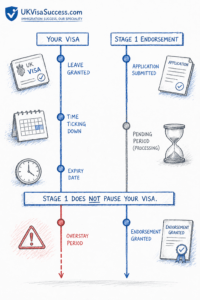
Why a Global Talent Visa Is Refused for Overstay: Stage 1 Does Not Extend Your Leave
Before looking at the case, you need to understand one legal fact that surprises even experienced applicants and sometimes advisers.
| The Rule (GT 2.2, Immigration Rules)
Under GT 2.2 of Appendix Global Talent, an applicant for permission to stay must not be in breach of immigration laws, unless the exceptions for overstayers under Part Suitability apply. A pending Stage 1 endorsement application is not an application for leave to remain. It does not pause or extend your existing visa. |
| Stage 1: Endorsement | Stage 2: Permission to Stay | |
| What it is | Assessment by Arts Council England (or another endorsing body) of your artistic merit | Application to the Home Office for leave to remain |
| Does it affect your visa? | NO. Your leave continues to expire on its original date. | Yes — a successful application grants up to 5 years’ leave |
| What happens if your visa expires during Stage 1? | You overstay. The Stage 1 process does not protect you. | The Home Office will assess suitability, including any overstay, before granting leave |
Under SUI 11.3 and SUI 11.4(a) of the Immigration Rules, an application may be refused where the applicant has overstayed their leave. The exceptions at SUI 11.5 and SUI 11.6 are narrow. Pursuing a Global Talent endorsement is not among them.
The Case: Global Talent Visa Refused for Overstay
How the problem started
James entered the UK in late 2024 on a Temporary Worker (Creative) visa. He is a community arts practitioner specialising in spoken word, oral tradition, and intergenerational storytelling. During his time in the UK, he ran workshops, participated in cultural exhibitions, and collaborated with community arts organisations.
However, before his leave even expired, serious disruption struck. An agent in his home country, whom he had used to help with travel arrangements, had fraudulently altered his documents — including his Certificate of Sponsorship — without his knowledge. When this came to light in early 2025, his sponsor cancelled the CoS and terminated the engagement. James was suddenly without sponsorship and with his visa due to expire in spring 2025.
Three endorsement applications, one critical misunderstanding
James decided to pursue the Global Talent route independently. He did not fully understand that pursuing Stage 1 would have no effect on his leave. Nevertheless, he made three endorsement applications over the course of 2025. The first two were refused. The third succeeded: Arts Council England endorsed him under the Exceptional Promise criteria in the field of Theatre in early 2026. By then, he had been without lawful status for approximately eight months.
The immigration surgery and the advice James relied on
Crucially, this is the most significant detail in the case. James did not simply ignore his immigration position. Shortly before his visa expired, he attended what was publicly advertised as a Home Office Immigration Surgery at a community centre in the North of England. He went specifically to ask whether he could stay while his Global Talent application was being pursued.
He states that a representative, whom he reasonably understood to be from the Home Office, after they checked his name and immigration details, told him he was eligible to remain. Acting on that assurance in good faith, James made no application to extend his leave.
When the Home Office refused his Stage 2 application, it noted that this account could not be verified because he had not provided a date, time, or name at the point of his explanation. His legal team subsequently obtained a contemporaneous event flyer confirming the surgery on the exact date James gave, a train ticket in his name showing travel to the location that day, and a formal letter from the event organiser confirming his attendance and the presence of Home Office Engagement Team staff.
The Legal Challenge: What an Administrative Review Can Actually Do
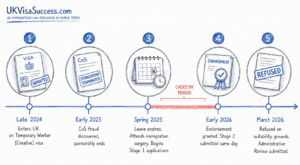
James’s case proceeded to Administrative Review (AR). This is not an appeal. The reviewer does not reconsider the whole case on its merits. They assess only whether the original decision-maker made a caseworking error: failing to apply the Rules correctly, failing to follow published guidance, or failing to properly engage with the evidence.
Furthermore, the legal representations in James’s case identified four specific errors:
- The decision-maker did not consider the explanation as a whole. The fraud, the misunderstanding, and the surgery advice each received separate treatment. Their combined effect on culpability was never assessed.
- The decision-maker dismissed the surgery evidence without adequate reasoning. The Home Office did not argue the advice was legally irrelevant — it argued the account could not be verified. That distinction matters enormously.
- The decision-maker did not follow the evidential flexibility policy. Published guidance requires a caseworker to request missing evidence before refusing, or to record why no request was made. The refusal did neither.
- The decision-maker did not properly engage with the consequences of the fraud. The Home Office dismissed it as an earlier event and failed to address how it led directly to James managing the process alone, and to his misunderstanding of Stage 1 versus Stage 2.
The Authorities Behind the Arguments
The representations cited R (Mandalia) v SSHD [2015] UKSC 59 (the Home Office must apply its own policies fairly), R (Lumba) v SSHD [2011] UKSC 12 (departure from published policy is unlawful), and Balajigari v SSHD [2019] EWCA Civ 673 (suitability reasoning must involve genuine engagement with the evidence, not mechanical dismissal).
| Is the case likely to succeed?
This is genuinely borderline. The overstay is real and significant. But the case has legal traction: the Home Office rejected the surgery account as unverified, not as legally irrelevant — and the evidence now obtained directly addresses the gap. If the AR succeeds, the decision is withdrawn and reconsidered. If it fails, options narrow sharply: there is no right of appeal to the Immigration Tribunal on this route. |
The Four Lessons Every Applicant and Adviser Must Take From This
- Stage 1 does not protect your leave. Plan your Stage 2 application — or an extension on another route — before your leave expires. This is non-negotiable.
- Document every significant immigration action you take. Train tickets, event flyers, emails, and photos. James’s case turned on whether he could prove he attended a surgery months earlier. The evidence existed — but only because he had kept it.
- Informal advice, however well-intentioned, cannot be relied upon without verification. The legal question here is not whether the advice was correct but whether James’s reliance on it was properly assessed. Always check any advice against official UKVI guidance at gov.uk.
- When third-party misconduct disrupts your immigration position, get regulated advice immediately. James’s decision to manage the process alone — understandable given his experience with the fraudulent agent — cost him. An IAA-registered adviser in early 2025 would almost certainly have prevented the overstay.
Frequently Asked Questions
Does a Global Talent endorsement application extend my visa?
No. A Stage 1 application is not an application for leave to remain. It does not engage Section 3C of the Immigration Act 1971 and has no effect on your existing leave.
What is Administrative Review and how long do I have?
Administrative Review is a Home Office process to correct caseworking errors in eligible refusal decisions. It must be submitted within 14 days of the refusal decision (28 days from outside the UK), via the UKVI online portal. The fee is £80. If successful, the decision is withdrawn and reconsidered by a different caseworker.
As an IAA adviser, what must I check before a Global Talent Stage 2 submission?
Verify that the applicant has maintained continuous lawful leave, or has a properly evidenced basis to argue suitability exceptions. Check that the Stage 1 endorsement is within its validity period (typically three months from the grant date). Identify any other suitability concerns. If complications exist, seek supervisor oversight before proceeding.