
EUSS Settled Status Absences: What the Rules Allow
You Have Lived Here for Five Years. But Have You Really?

You have lived in the UK for five years. You have your passport in front of you and your travel history open on screen. And you can already see the problem: not one extended absence, but two. Both trips lasted more than six months. One occurred during COVID. The other took you back to your home country when armed conflict broke out there, and you felt compelled to help. You had powerful reasons for both. Now you need to know whether those reasons satisfy the rules.
EUSS settled status absences of this kind: two extended trips within a single five-year qualifying period — sit at the edge of what Appendix EU permits. The standard rule allows only one extended absence. Two is where most applicants stop, assuming they are automatically disqualified. Most of them are wrong to stop there.
Viktor, a dual national from Central Europe who arrived in the UK in late 2020 as a university student. He accumulated a COVID-related absence in his first year, then returned to his home region in 2022 to provide humanitarian assistance during an armed conflict. His EUSS settled status application raised both absences — and both were successfully argued.
The Legal Framework: Continuous Residence and EUSS Settled Status Absences
Under Appendix EU of the Immigration Rules, settled status requires a continuous qualifying period of five years’ UK residence. Importantly, ‘continuous’ does not mean unbroken physical presence. However, absences must remain within defined limits.
| The Core Rule (Appendix EU, Annex 1 — definition of continuous qualifying period)
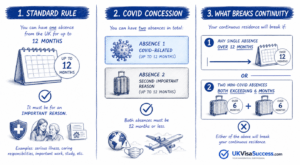
A continuous qualifying period is not broken by a single absence of up to 12 months where that absence was for an important reason — such as pregnancy, childbirth, serious illness, study, vocational training, an overseas posting, or COVID-19. A second extended absence will, under the standard rule, break continuity and require the five-year qualifying period to restart from the date of return. |
The key phrase is ‘important reason.’ Crucially, the list in the Rules is explicitly non-exhaustive. The Home Office guidance confirms that caseworkers must consider each case individually, and that no closed list of acceptable reasons exists. In practice, this gives caseworkers genuine discretion to accept compelling circumstances that fall outside the listed examples.
The standard position, however, permits only one extended absence during the five-year period. A second absence exceeding six months would, without more, break continuity entirely — unless a specific concession applies.
EUSS Settled Status Absences and the COVID Concession: Viktor’s Case
The COVID-19 Exception for a Second Extended Absence
Here is where Viktor’s case, and thousands like it, becomes legally significant. The Home Office introduced a specific policy concession for applicants who accumulated two extended absences, provided one of those absences was COVID-related. The EUSS guidance (updated August 2024) states:
| Home Office COVID Concession (EUSS Guidance, updated August 2024)
“Where an applicant has a second period of absence exceeding 6 months, they have exceeded the absence normally permitted under Appendix EU. However, they can still apply for settled status where they can evidence that one of those periods of absence of up to 12 months was because of coronavirus.” |
In plain English: if you have two long EUSS settled status absences and one was genuinely COVID-related, the Home Office will not automatically refuse the application. The COVID absence sits outside the standard rule. The second absence, whatever its reason, is then assessed on its own merits as a potential important reason.
Viktor’s First Absence: COVID-19
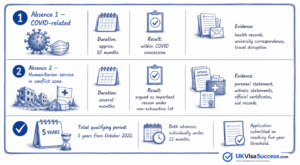
Viktor arrived in the UK in October 2020 to begin university studies. Within weeks, the COVID-19 pandemic forced him to return home. He remained away for approximately ten months, affected by personal health concerns, lockdown restrictions, and the collapse of normal travel arrangements.
This first absence was the more straightforward of the two to argue. The Home Office guidance explicitly accepts any coronavirus-related reason, including choosing to remain abroad because of the pandemic. Viktor’s evidence included university correspondence confirming remote study permission, health documentation, and records of travel disruption. The absence fell comfortably within the 12-month limit and clearly within the COVID policy.
Viktor’s Second Absence: Humanitarian Service in a Conflict Zone
In early 2022, following the outbreak of war in his home region, Viktor voluntarily returned to assist with the humanitarian response. He worked with local organisations for several months, providing aid, transport, and support to affected communities. Thereafter, he returned to the UK and resumed his studies.
This second absence required a more careful legal argument. Volunteering in a conflict zone does not appear in Appendix EU’s list of important reasons — it is neither an overseas posting, a study placement, nor a medical situation. The legal representations therefore had to establish that the absence fell within the spirit of the non-exhaustive ‘important reason’ framework, supported by evidence strong enough to satisfy a caseworker exercising individual discretion.
The Evidence Bundle for the Second Absence
The application included a detailed personal statement from Viktor explaining his motivations, activities, and the humanitarian context. Additionally, the bundle contained:
- Witness statements from four individuals with direct knowledge of Viktor’s activities during the absence
- Official certificates and letters of appreciation from the local organisations he worked with
- Humanitarian aid delivery records documenting specific activities
- Travel records confirming the exact dates of departure and return
- Background materials contextualising the conflict and humanitarian situation
The central argument was that Viktor’s absence was not a personal choice made for convenience or lifestyle reasons. It was a proportionate and time-limited response to an extraordinary humanitarian crisis, conducted transparently, before he returned to complete his studies. The guidance’s non-exhaustive framework and individual assessment requirement provided the legal opening. The evidence bundle provided the closing argument.
How to Prepare an Application with Two Extended Absences: A Five-Step Framework
- Establish the COVID concession: Confirm that one absence was COVID-related and under 12 months. Without this, the two-absence route is not available.
- Verify the 12-month maximum for each absence individually: Both absences must each remain under 12 months. If either exceeds this, the concession does not apply.
- Build the evidence file for the COVID absence: Compile health records, university or employer correspondence permitting remote study or work, travel disruption evidence, and a personal statement.
- Build the evidence file for the second absence: Every claim about the purpose and nature of the second absence requires documentary support — not just a personal statement alone.
- Prepare written representations: Submit a detailed argument alongside the application explaining how each absence qualifies and why discretion should be exercised in your favour.
The COVID Concession Changes the Framework, Not the Outcome
The COVID concession means an application is not automatically refused because of two extended EUSS settled status absences. It does not guarantee approval. The second absence, regardless of its reason, must still satisfy the caseworker as an important reason. That decision remains discretionary and rests on the individual facts. No applicant can insist on a favourable exercise of that discretion.
Getting the evidence right is therefore not a procedural nicety — it is the entire case. A well-structured evidence bundle transforms a borderline application into one that a caseworker can approve with confidence.
Evidence Requirements for Both Absences
| What must be evidenced | Why |
| COVID absence: health, lockdown impact, travel disruption, university or employer permission | Without this, the COVID concession cannot be claimed with confidence and the application falls into the standard two-absence rule |
| Second absence: who you were with, what you did, for how long, and why it was necessary | Bare assertion is insufficient. The caseworker must be able to verify the nature and purpose of the absence from documentary evidence |
| Continuous UK residence for the remaining qualifying period | Tenancy agreements, bank statements, university records, utility bills — the Home Office examines the whole five-year picture |
| Identity, current pre-settled status, and any previous leave documentation | Technical completeness is essential. Procedural gaps cause delays or refusals regardless of the merits of the absence argument |
| IMPORTANT
Cases involving two extended absences should never be submitted without a full evidential bundle and detailed written representations. The standard online EUSS application form does not provide adequate space to argue discretionary circumstances. Representations submitted alongside the application are not optional — they transform a borderline case into a winnable one. Always verify that each individual absence falls within the 12-month maximum and that each absence is individually supportable before advising a client to proceed. |
Prepare Carefully
EUSS settled status absences involving two extended trips do not automatically disqualify an application but they demand careful preparation. The COVID concession opens the door. Evidence and written representations determine what happens on the other side.
If your absence record is complicated, getting the legal framework right before submitting is significantly more effective than relying on an appeal to remedy an underprepared application. For further reading, see our related articles on continuous qualifying periods under Appendix EU and the EUSS pre-settled to settled status upgrade process.
Frequently Asked Questions
I have two absences over six months. Can I still apply for EUSS settled status?
Possibly yes, if one of the absences was COVID-related. The Home Office introduced a specific concession allowing applicants with two extended EUSS settled status absences to apply, provided one absence was coronavirus-related and both were individually under 12 months. The second absence must still be accepted as an important reason. This requires strong evidence and, in most cases, written representations submitted alongside the application.
Does volunteering in a conflict zone count as an important reason under Appendix EU?
The list of important reasons in Appendix EU is non-exhaustive. Furthermore, the Home Office guidance confirms that caseworkers must consider each case on its individual merits. Humanitarian service in response to armed conflict is arguable as an important reason, particularly where it is evidenced in detail and was limited in duration. However, it is not automatic and it is precisely the kind of situation where regulated immigration advice and a properly structured evidence bundle are essential.
What evidence do I need for a COVID-related absence under the EUSS?
The Home Office accepts any coronavirus-related reason, including choosing to remain abroad during the pandemic. Helpful evidence includes health records, university or employer correspondence permitting remote working or study, records of flight cancellations or suspended routes, quarantine notifications, and a personal statement explaining the specific circumstances. Additionally, evidence that you returned to the UK as soon as practically possible strengthens the argument considerably.
What happens if my EUSS settled status application is refused?
A refusal can be challenged by way of an appeal to the First-tier Tribunal (Immigration and Asylum Chamber). Notably, EUSS applicants do have a right of appeal, which distinguishes this route from, for example, the Global Talent visa. However, appeals are lengthy and costly. The stronger approach is consequently to submit a properly prepared application with professional advice and a complete evidence bundle, rather than relying on an appeal to correct an underprepared case.