
Section 4L British Citizenship: Fixing Historic Nationality Injustice
When a Family History Reveals a Hidden Claim to British Citizenship
Simon arrived in the United Kingdom legally in 2008. Over the following years, however, he faced repeated immigration enforcement. At one stage he was detained and left destitute. The experience caused severe psychological trauma.
Only recently did he discover something extraordinary about his family history.
His father was born in Trinidad and Tobago in the late 1960s. His grandmother was born in Grenada in the 1920s. When researchers examined the family’s nationality history, they identified a critical legal barrier.
Because the grandmother was a woman, historic nationality laws prevented her from registering her child at a British consulate abroad. If she had been a man, the process would have been possible.
That single legal inequality may have prevented two generations from acquiring British citizenship.
Cases like this reveal a hidden truth about British nationality law. Thousands of families were affected by discriminatory legislation that operated quietly for decades. Today, Section 4L of the British Nationality Act 1981 exists to correct those historic injustices.
Understanding how that provision works is crucial for anyone whose citizenship history involves colonial connections, maternal nationality, or administrative failures by public authorities.
The Legal Mechanism That Corrects Historic Nationality Discrimination
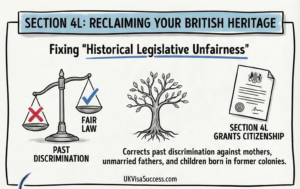
Section 4L was inserted into the British Nationality Act 1981 by the Nationality and Borders Act 2022.
Its purpose is simple in principle but complex in practice.
The Home Secretary may register a person as a British citizen if they would have become a citizen earlier but for one of three circumstances:
- historical legislative unfairness
- an act or omission by a public authority
- exceptional circumstances relating to the applicant.
The phrase historical legislative unfairness lies at the heart of most cases.
For much of the twentieth century, British nationality law treated men and women differently. Under the British Nationality Act 1948, citizenship could normally pass through the father but not through the mother.
This meant that:
- British mothers could not transmit citizenship in the same way as fathers
- children born outside marriage were treated differently
- registration procedures sometimes depended on the father’s nationality status.
When these rules operated in former British colonies, the consequences often became even more complicated.
Families who should have had a pathway to British citizenship instead found themselves excluded because of technical legal barriers that no longer reflect modern equality principles.
Section 4L was designed to repair precisely those historical outcomes.
Why These Citizenship Claims Are So Difficult to Prove
Although the legal intention behind Section 4L is clear, proving a claim is rarely straightforward.
Caseworkers do not simply accept that discrimination existed. Applicants must demonstrate something far more precise.
They must show that but for the discriminatory law or public authority failure, they would have acquired British citizenship.
That requirement creates a difficult evidential challenge.
Nationality law operates mechanically. A person either meets the statutory requirements or does not. When analysing historic claims, the Home Office therefore reconstructs the legal framework that applied decades earlier.
Caseworkers ask questions such as:
- What nationality status did the applicant’s grandparent hold at birth?
- Would the parent have acquired citizenship under the law in force at that time?
- Was there a legal route to register the child’s birth abroad?
These questions require applicants to examine legislation from the 1940s, 1950s, and 1960s.
For individuals already dealing with trauma, financial hardship, or unstable immigration status, gathering this historical evidence can feel overwhelming.
Three Real Situations Where Section 4L May Apply
To understand how Section 4L operates in practice, it is helpful to consider several realistic situations.
Scenario 1: Citizenship Lost Through Maternal Transmission Rules
Consider a child born overseas in 1970.
The child’s mother was a Citizen of the United Kingdom and Colonies, but the father held another nationality. At that time, British mothers could not pass citizenship automatically to children born abroad.
If the law had treated mothers and fathers equally, the child would have acquired citizenship at birth.
Section 4L may allow that individual to register as a British citizen today.
Scenario 2: Consular Registration That Could Never Occur
In some cases, citizenship depended on registering a birth at a British consulate.
Imagine a child born in the Caribbean in the 1960s to a British citizen mother. Because only fathers could register children abroad, the consulate could not accept the registration.
Decades later, the adult child may now apply under Section 4L on the basis that discriminatory registration rules prevented citizenship.
Scenario 3: Administrative Failure by a Public Authority
Not all Section 4L cases involve discriminatory legislation.
Sometimes the barrier was administrative.
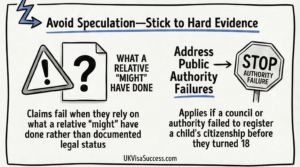
For example, a child entitled to register as a British citizen before age 18 might have been in local authority care. If the council failed to identify that legal entitlement, the registration deadline passed.
Section 4L allows the Home Secretary to correct such omissions by public authorities.
Strategic Approach to Building a Section 4L Application
Anyone pursuing a Section 4L claim must approach the process methodically.
These applications are rarely successful when submitted without careful preparation.
The first task is reconstructing the family’s nationality history. This requires identifying the legal status of parents and grandparents under the law in force at the time of their birth.
Key evidence often includes:
- birth certificates across multiple generations
- marriage records
- historical nationality documentation
- immigration records.
Many applicants also rely on Home Office Subject Access Requests to obtain their historic immigration files.
The second task is identifying the exact legislative barrier that caused the injustice. Simply stating that discrimination existed is not enough. Applicants must point to the specific provision that prevented citizenship.
Finally, the application must explain how the outcome would have differed if that legal barrier had not existed.
Errors That Commonly Destroy Section 4L Claims
Many Section 4L applications fail for predictable reasons.
One common mistake is relying on speculation. Applicants sometimes argue that a relative might have applied for citizenship under different circumstances. The Home Office requires a much stronger argument.
Another frequent problem involves incomplete documentation. Without evidence establishing nationality status across generations, caseworkers cannot confirm that citizenship would have been acquired.
Applicants also sometimes overlook alternative registration routes. In some situations, provisions such as Section 4C or Section 4F may provide a more direct route to citizenship.
Submitting the wrong application route can lead to unnecessary refusals.
Why the Government Created Section 4L

Section 4L reflects an important shift in nationality policy.
Earlier nationality legislation reflected social attitudes that treated women and children born outside marriage differently. Over time, these rules became increasingly difficult to justify.
Parliament therefore introduced corrective provisions designed to align nationality law with modern equality principles.
However, policymakers also wanted to avoid rewriting citizenship history entirely.
For that reason, Section 4L focuses narrowly on correcting situations where the applicant can demonstrate a direct causal link between discrimination and the loss of citizenship.
This balance explains why the provision exists but is applied cautiously.
Frequently Asked Questions
Can I claim British citizenship if my grandmother was British?
Possibly. If historical laws prevented your grandmother from passing citizenship to your parent or registering their birth abroad, Section 4L may allow you to register as a British citizen today. Each case depends on the nationality status of earlier generations and the legislation in force at the time.
Does Section 4L apply to discrimination against unmarried fathers?
Yes. Historic nationality laws often prevented unmarried fathers from transmitting citizenship. In some circumstances, Section 4L can correct that injustice if the applicant can show the law directly prevented the acquisition of citizenship.
Do I need historical documents to apply?
Yes. Evidence showing the nationality status of parents and grandparents is essential. Birth certificates, marriage records, and nationality documents are commonly required. Without these records, the Home Office may be unable to confirm that citizenship would have been acquired under earlier legislation.
Can the Windrush Scheme help in these cases?
In some situations it can. If the applicant or their family belongs to the Windrush generation, the Windrush Scheme may help confirm lawful residence or provide compensation. However, citizenship claims under Section 4L are assessed separately.
Do I need legal advice before applying?
Because Section 4L applications involve analysing historic nationality legislation, many applicants choose to seek professional advice. A specialist can help reconstruct the legal chain of citizenship and identify the strongest registration route.
The Strategic Lesson Behind Section 4L
For many families, the discovery of a hidden citizenship claim begins with a simple question about ancestry.
What follows is often a complex legal investigation into decades of nationality legislation.
Section 4L offers a powerful opportunity to correct historic injustices. But success depends on building a precise legal argument supported by detailed evidence.
If your family history includes British citizenship connections, colonial nationality status, or maternal nationality barriers, it may be worth examining the law more closely.
Correcting the past is not always easy. But in some cases, the law now provides a path forward.