
ILR English Requirement 2027: B2 Rules Explained
From 26 March 2027, the UK government will raise the English language requirement for Indefinite Leave to Remain (ILR). Most applicants must demonstrate B2-level English ability, replacing the current B1 requirement. The change affects Skilled Worker, Global Talent, family routes, and long-residence applicants. Any ILR application submitted after this date must satisfy the higher B2 standard or face refusal.
The 2027 Rule Change That Could Disrupt Settlement Plans
Many migrants assume immigration rules remain stable throughout their visa journey. Unfortunately, this assumption often proves costly. The Home Office periodically revises settlement requirements, and the upcoming English language reform represents one of the most significant policy adjustments in recent years.
The Statement of Changes in Immigration Rules (HC 1691), published on 5 March 2026, formally raises the English language requirement for settlement.
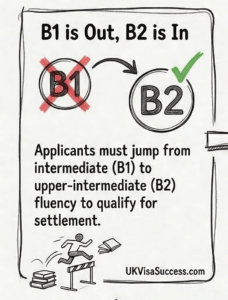
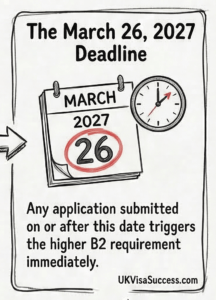
Applicants submitting ILR applications on or after 26 March 2027 must now demonstrate B2-level English ability, rather than the previous B1 standard.
This may appear to be a small technical adjustment. In reality, it introduces a substantial new barrier for many applicants already progressing toward settlement.
Failing to meet the B2 requirement will lead to refusal. Refusals mean lost application fees, delayed settlement, and the potential need to extend an existing visa. In some cases, applicants may face thousands of pounds in additional immigration costs.
Understanding this rule early allows applicants and advisers to plan strategically. This guide explains how the B2 requirement works, who it affects, and how to prepare effectively.
Key Insights About the 2027 B2 Requirement
Before examining the legal details, several strategic realities deserve attention.
The Rule Applies to Existing Settlement Routes
The B2 requirement does not only affect migrants entering the UK after 2027. It also applies to people already several years into their immigration journey.
For example, someone who began a Skilled Worker visa in 2022 may still fall under the new rule if their ILR eligibility date occurs after 26 March 2027.
This means thousands of applicants who initially planned for the B1 requirement will now face a higher language standard.
Application Timing Has Become Strategically Important
The exact date of submission determines which English standard applies.
Applicants whose qualifying period ends in early March 2027 may still rely on the B1 standard if they apply before the deadline. Missing this window by even a single day triggers the new B2 requirement.
For applicants approaching settlement around 2027, precise timeline calculations are now critical.
B2 Represents a Significant Language Upgrade
Many applicants underestimate the difference between B1 and B2 English levels.
B1 demonstrates intermediate ability suitable for everyday communication. B2 requires stronger fluency, deeper vocabulary, and the ability to discuss complex topics confidently.
For individuals who previously relied on minimal preparation for language tests, achieving B2 may require several months of study.
Why the Government Is Raising the English Requirement
Language ability plays a central role in the UK government’s integration policy.
The May 2025 White Paper “Restoring Control over the Immigration System” outlined a broader objective to improve long-term integration outcomes for migrants settling in the UK.
Increasing the English requirement forms part of this policy direction.
Currently, the Immigration Rules require applicants under Appendix English Language and Appendix KOLL to demonstrate speaking and listening ability at B1 level.
The March 2026 Statement of Changes updates this requirement. From 26 March 2027, settlement applicants must demonstrate B2 level ability on the CEFR scale.
The two-year transition period gives migrants time to improve their language skills before the new standard becomes mandatory.
However, once implemented, the rule will apply strictly.
Which Immigration Routes Are Affected?
The B2 requirement applies across a wide range of settlement pathways.
These include:
- Skilled Worker route
• Global Talent route
• UK Ancestry route
• Long Residence (10-year route)
• Family life routes
• Partner and spouse visas
• Private Life routes
In practice, almost all migrants seeking settlement must now plan for B2 English.
Applicants must prove this ability by passing a Secure English Language Test (SELT) at an approved UKVI test centre, unless they qualify for a legal exemption.
Real-World Scenarios: How the Rule Affects Applicants
The consequences of the B2 rule vary significantly depending on individual immigration history.
The following examples illustrate how complex situations can arise.
Scenario 1: The Skilled Worker Timeline Shift
Mateo arrived in the UK on a Skilled Worker visa in January 2022. Initially, he expected to qualify for settlement in January 2027, comfortably before the B2 deadline.
However, Mateo changed employers in 2024. During the transition he spent two months outside the UK, interrupting his continuous residence calculation.
His ILR eligibility date therefore moves to April 2027.
This small timeline shift now places his application after the B2 rule begins.
Mateo cannot rely on the B1 certificate he planned to use. He must pass a new B2 Secure English Language Test before applying.
Scenario 2: The Spouse Visa Upgrade Problem
Aisha entered the UK on a spouse visa in late 2022. She successfully passed an A2 English test when extending her visa in 2025.
Based on older guidance, she expected to upgrade to B1 for settlement.
However, Aisha plans to apply for ILR in November 2027. The B1 requirement will no longer exist by then.
Instead, she must jump directly from A2 to B2, a considerably larger step than she anticipated.
Without early preparation, she risks failing the language requirement and delaying her settlement.
Scenario 3: The Long Residence Applicant with Expired Evidence
David has lived in the UK across several visa categories, including Student, Graduate, and Skilled Worker visas.
He qualifies for settlement under the 10-year Long Residence route in May 2027.
David previously passed a B2-equivalent English test in 2017 while applying to a UK university.
However, English test results used for immigration must be less than two years old.
Despite demonstrating strong language ability, David must still sit a new B2 Secure English Language Test before submitting his ILR application.
Strategic Planning Advice for Settlement Applicants
Preparing early can prevent unnecessary stress and financial loss.
Applicants approaching settlement after 2027 should treat the B2 requirement as a central part of their immigration strategy.
Conduct a Precise Timeline Review
Start by calculating your exact settlement eligibility date.
Review the date your qualifying visa was granted. Confirm that your continuous residence requirement remains intact.
If your ILR date falls before 26 March 2027, you may still rely on the B1 requirement. If it falls after that date, you must prepare for B2.
Build a Six-Month Preparation Buffer
Language exams occasionally require multiple attempts.
We recommend booking your first B2 test at least six months before your intended application date.
This provides time for retakes if necessary and prevents last-minute complications.
Verify Exemptions Early
Some applicants can avoid the SELT requirement.
For example, you may qualify for exemption if:
- you hold citizenship from a majority English-speaking country
• you possess a recognised degree taught in English.
However, verifying an overseas degree often requires official confirmation from the Home Office’s qualification assessment provider.
Do not assume your degree automatically qualifies.
Common Pitfalls and Grey Areas
Language requirements often generate avoidable refusals.
Understanding common mistakes helps applicants avoid costly errors.
Booking the Wrong Type of English Test
Many applicants mistakenly book IELTS Academic or TOEFL tests used for university admissions.
These tests are often rejected for immigration purposes.
Settlement applicants must take a Secure English Language Test approved by UKVI.
Misunderstanding Nationality Exemptions
Some migrants assume they are exempt because English is widely spoken in their home country.
However, the Home Office maintains a strict list of majority English-speaking countries.
If your country does not appear on that list, you must take the test.
Using Expired Test Certificates
English test results expire after two years for immigration purposes.
Even applicants with excellent language ability must retake the test if their certificate is too old.
A Broader Shift in Immigration Policy
The introduction of the B2 requirement reflects a broader shift in UK immigration policy. Rather than simply regulating entry, the government is now placing greater emphasis on long-term integration standards.
Raising the English threshold aligns settlement requirements across multiple visa routes. From a policy perspective, this creates a consistent expectation that migrants seeking permanent residence should demonstrate strong communication skills.
For immigration advisers, this change highlights the importance of proactive client planning. Reviewing settlement timelines now allows advisers to warn clients about upcoming language obligations.
Without early preparation, many applicants may face unexpected delays when applying for ILR after 2027.
Frequently Asked Questions
When does the B2 requirement legally begin?
The new requirement applies to settlement applications submitted on or after 26 March 2027. Applications submitted before this date continue to follow the B1 standard.
Which visa routes are affected by the change?
The rule affects most settlement pathways, including Skilled Worker, Global Talent, Long Residence, Family Life routes, and partner visas.
Can I use an older B2 certificate?
Only if the certificate was issued within two years of your ILR application date. Older certificates will normally be rejected.
Are all English-speaking countries exempt from the test?
No. The Home Office provides a strict list of majority English-speaking countries. Only nationals of those countries qualify automatically.
How can I prove my overseas degree was taught in English?
You must obtain confirmation from the Home Office’s qualification and language assessment provider (ECCTIS) verifying that your degree meets UK equivalency standards.