
Administrative Review: Updating Financial Evidence
When the “Good News” Email Creates a New Risk
Ahmed had almost forgotten about his visa application. Six months earlier, his UK student visa had been refused. The decision letter stated that his financial evidence did not meet the Immigration Rules. Ahmed believed the refusal was wrong and requested an Administrative Review.
Then one morning the email arrived. The Home Office confirmed that the refusal decision had been withdrawn. His application would now be reconsidered.
For a brief moment, Ahmed believed the problem had been solved. But the next paragraph changed everything. The Home Office asked him to submit updated financial evidence within 10 working days.
Ahmed immediately checked his bank account. The savings he relied on in his original application were gone. During the months waiting for the Administrative Review result, he had already paid part of his tuition fees.
Panic set in. Friends suggested an easy solution: borrow money from family and deposit it into the account before submitting the updated bank statement. It sounded practical. But it could also lead to a second refusal.
Situations like Ahmed’s are increasingly common when visa refusals are withdrawn following Administrative Review. Understanding how the Home Office evaluates updated financial evidence is therefore critical if applicants want to avoid creating new credibility concerns.
The Reality Behind a Withdrawn Visa Refusal
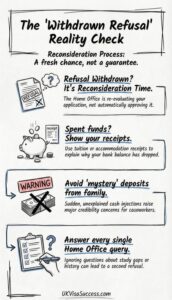
A withdrawn refusal often creates false confidence among applicants.
Many assume the Home Office has accepted their application and only needs minor clarification before issuing the visa. In practice, the legal position is different.
Administrative Review exists to correct caseworking errors. When the review team identifies a potential error in the original decision, the refusal may be withdrawn and the application returned to a decision-maker.
The application must then be reconsidered under the Immigration Rules.
This reconsideration does not automatically guarantee a successful outcome. The caseworker must still determine whether the applicant satisfies the requirements of the relevant immigration route.
Where financial evidence played a role in the original refusal, updated documentation is often requested before a new decision can be made.
This is where many applicants encounter difficulty.
Months may have passed since the original application. Bank balances change. Funds may have been used to pay tuition fees, accommodation deposits, or other expenses.
The Home Office therefore focuses on a critical question:
Were the funds relied upon in the application genuinely available to the applicant?
Why Financial Evidence Becomes the Central Issue
Financial evidence often becomes the focal point during reconsideration because immigration routes that rely on personal funds require caseworkers to assess credibility as well as documentation.
The Immigration Rules generally require applicants to demonstrate that they have access to sufficient funds to support their stay. This may include tuition fees, living expenses, or other costs depending on the visa category.
Bank statements are therefore used not only to verify a balance but also to establish whether the funds are genuinely available to the applicant.
During reconsideration, caseworkers frequently examine the movement of funds between the original application and the reconsideration request.
A falling bank balance is not necessarily problematic. Legitimate payments such as tuition fees or accommodation deposits can explain the reduction.
However, sudden unexplained deposits can raise questions.
Caseworkers may ask:
- Where did the new funds come from?
- Were the original funds genuinely available?
- Is the financial history consistent with the application?
These questions explain why applicants must approach updated financial evidence carefully.
Three Complex Situations Applicants Commonly Face
Real Administrative Review cases rarely follow simple patterns. Financial evidence often intersects with wider credibility issues.
The following scenarios illustrate the kinds of situations applicants encounter.
Scenario 1: Tuition Paid During the Review Period
Sara applied for a student visa relying on savings shown in her bank statements. Her visa was refused due to a caseworker error, and she requested an Administrative Review.
While waiting for the outcome, she paid £8,000 in tuition fees to secure her place at the college.
Six months later the refusal was withdrawn. The Home Office asked for updated financial evidence.
Sara’s bank account now contained significantly less money than before.
However, she submitted:
- an updated bank statement showing the tuition payment
- an official fee receipt from the college
- a confirmation of enrolment letter.
The documents clearly explained where the funds had gone. The payment aligned with the purpose of the visa.
The financial evidence remained credible.
Scenario 2: Replacing Spent Funds with New Deposits
Daniel relied on savings to meet the financial requirements of his visa application.
While waiting for the Administrative Review outcome, he used those savings for unrelated personal expenses.
When the refusal was withdrawn and updated evidence was requested, Daniel borrowed money from relatives and deposited it into his account shortly before submitting the bank statement.
The balance appeared sufficient again.
However, the caseworker noticed the recent deposit and requested clarification regarding the source of the funds.
The situation now required Daniel to explain both the disappearance of the original funds and the origin of the new deposit.
This type of financial history can create credibility concerns if the explanation is unclear or inconsistent.
Scenario 3: Financial Evidence Revealing Wider Credibility Issues
Sometimes financial requests uncover unrelated issues.
Priya received a request for updated financial documents after her refusal was withdrawn. The Home Office also asked her to explain what she had been doing since completing her previous course three years earlier.
Priya focused entirely on the financial evidence and submitted updated bank statements.
She did not respond to the question about her activities during the three-year period.
The caseworker considered the response incomplete. The unexplained timeline gap created additional concerns about the credibility of the application.
Administrative Review reconsideration therefore requires applicants to respond fully and carefully to every issue raised.
How Applicants Should Approach Updated Evidence
When the Home Office requests updated financial evidence after Administrative Review, preparation becomes critical.
Applicants should begin by reviewing the financial documents originally submitted with their application. Understanding the original evidence allows applicants to explain any changes clearly.
Where funds have been spent, supporting documents should be collected immediately. These may include tuition receipts, accommodation invoices, or official payment confirmations.
Providing documentary evidence that explains the movement of funds can prevent misunderstandings during reconsideration.
Applicants should also consider providing a short written explanation describing the financial timeline. A clear explanation helps the caseworker understand why the account balance has changed since the original application.
Most importantly, applicants must ensure that every question in the Home Office request is answered.
Reconsideration requests often contain several different queries. Addressing only one aspect of the request can lead to further concerns.
Common Mistakes That Create New Problems
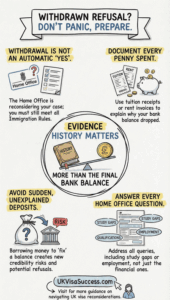
Administrative Review reconsiderations frequently fail because applicants misunderstand how caseworkers interpret financial evidence.
One common mistake is submitting updated bank statements without explaining changes in the balance. Even legitimate transactions can appear suspicious if no explanation is provided.
Another mistake is assuming that a withdrawn refusal means the application will inevitably succeed. The reconsideration stage still requires the Home Office to verify that all Immigration Rule requirements are met.
Applicants also sometimes overlook additional questions included in the evidence request. Ignoring requests for clarification about employment history, study gaps, or the source of funds can undermine the overall credibility of the application.
Consistency between the original application and updated evidence is therefore essential.
Understanding the Policy Logic Behind Financial Scrutiny
The Home Office places significant emphasis on financial credibility because immigration routes that rely on personal savings can be vulnerable to temporary financial arrangements.
Caseworkers therefore assess not only whether funds exist but whether they were genuinely available to the applicant.
This explains why the history and movement of funds often receives greater scrutiny than the balance itself.
Where applicants provide a clear documentary trail showing legitimate financial activity, reconsideration can proceed smoothly.
However, unexplained financial changes or inconsistent explanations may lead caseworkers to question whether the requirements of the Immigration Rules have truly been met.
Frequently Asked Questions
Does a withdrawn refusal mean my visa will be granted?
No. A withdrawn refusal means the Home Office believes the original decision may have contained an error. The application must still be reconsidered under the Immigration Rules before a final decision is made.
Can the Home Office ask for new financial documents?
Yes. If the original documents are outdated or clarification is needed, the Home Office may request updated evidence before making a new decision.
What if I spent the money used in my original application?
Applicants should provide documentary evidence explaining how the funds were used. For example, tuition receipts or accommodation payments may demonstrate legitimate expenditure.
Will recent deposits in my account be questioned?
Recent deposits are not automatically problematic. However, applicants may be asked to explain the source of the funds and ensure the financial history remains consistent with the application.
Evidence Matters More Than Balance
When a visa refusal is withdrawn after Administrative Review, many applicants focus only on the balance shown in their bank account.
In reality, the Home Office is examining something more important.
Caseworkers are trying to determine whether the financial evidence supporting the application is credible and consistent.
Applicants who provide a clear explanation of their financial history, supported by documentary evidence, are far better positioned to navigate the reconsideration process successfully.
Before submitting updated documents, review the evidence carefully and ensure that every change in your financial position can be explained clearly.
A well-prepared response often makes the difference between resolving a refusal and creating a second one.